By Adnan Rahman · 30 Jul 2026
Autoscaling, Cold Starts, and Cost Efficiency: How to Balance Cloud Performance and Spend

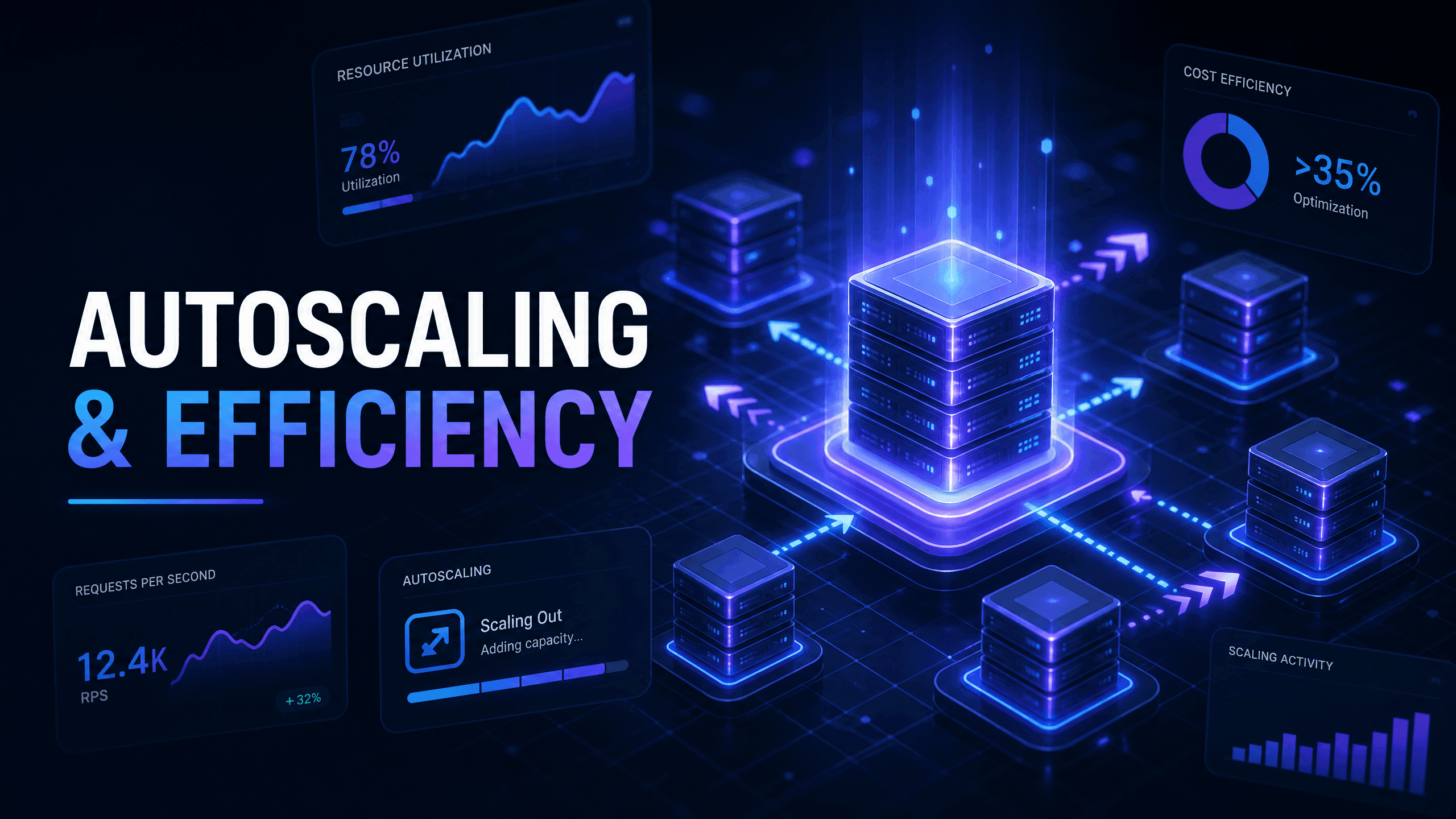
Autoscaling sounds like the perfect cloud solution: traffic goes up, your infrastructure scales out; traffic drops, it scales back down. Simple. But anyone who has worked with cloud systems knows it is not always that smooth. New containers, virtual machines, or serverless functions still need time to start up, load dependencies, warm caches, and connect to databases. That delay is what we call a cold start and when it happens at the wrong moment, users feel it as lag, slow responses, or even timeouts.
Why Scaling is Not Enough
Here is the real issue: more capacity does not automatically mean more readiness. A cloud platform can detect rising demand and start scaling within seconds, but those new resources may still need a little time before they are ready to serve traffic. During that window, your app can still struggle even though everything looks fine on the dashboard. That is why cloud performance is not just about adding instances, it is about making sure they are ready when people need them.
The Cold-Start Problem
Cold starts are easy to overlook until they start hurting the user experience. They happen when a fresh execution environment must be provisioned before it can handle a request. This shows up a lot in serverless platforms and fast-scaling workloads. Even a small startup delay can snowball quickly: requests begin to queue, retries increase, downstream services take more pressure, and the whole system starts to feel less stable. In busy environments, startup time is not a background detail, it is part of the performance story.
Cost and Efficiency Trade-offs
This is where the trade-off becomes real. Every autoscaling strategy sits somewhere between performance and cost efficiency. Scale too slowly, and users may run into slow pages, failed requests, or inconsistent performance during traffic spikes. Scale too aggressively, and you are paying for idle resources that are not doing much. Traditional always-on infrastructure gives you readiness, but often at a higher cost. More elastic and serverless models are great for cost optimization, but they make cold start latency much more noticeable.
Practical Ways to Reduce Pain
So, what helps? In practice, teams try to design for ready capacity, not just theoretical scale. That can mean pre-warmed instances, predictive autoscaling, connection pooling, warm pools, or simply making startup paths lighter and faster. If traffic patterns are predictable, scheduled scaling can work well because it gets capacity ready before the spike hits. The best approach depends on the workload: bursty systems need fast activation, steady services need efficient baselines, and latency-sensitive apps may be better off keeping some resources warm all the time.
Design Principles That Hold Up
At the end of the day, good cloud architecture starts with the user experience, not the scaling chart. If your application is sensitive to latency, paying a little extra to keep resources warm may be the right call. If a short delay is acceptable, a more elastic model can save a lot of money. The important thing is to match startup time, traffic patterns, and scaling rules to real business needs. When those pieces line up, you get a system that feels fast, scales cleanly, and stays cost-efficient.
Conclusion
Autoscaling is powerful, but it is not magic. If you want responsive cloud systems, you must think about cold starts, readiness gaps, and the real cost of keeping capacity available. The strongest architectures are the ones that can absorb traffic spikes without slowing users down and still stay financially efficient when demand settles. That is where the real balance between cloud performance and cloud cost optimization happens.
Related Articles


Get started today and unlock the power of our solutions.
Try Inovetix free and see how simple smarter selling can be - no credit card required.
Have a project?
Let's connect!
Inovetix brings your team, clients, and data into one powerful workspace, turning everyday clutter into a smooth, focused rhythm of growth.
1:1 Call
Want to discuss your vision over a call? Book a free call with us and see how we can help you.